
For years I worked in multicultural teams, both overseas and here in Australia, and the same thing kept happening to me. I would spot a problem and talk it through privately with a colleague, often someone from an Asian background. We would agree completely that it needed to be raised in the meeting. Then we would walk into the room, the moment would come, and I would be the only one who said it. The colleague who had agreed with me an hour earlier sat quietly and said nothing.
It frustrated me for a long time. It looked as though I was the only person who had noticed the problem, which meant it often went unaddressed, and I was left carrying it on my own. I read the silence as a lack of support. I thought I had been left hanging.
What I came to understand is that I was reading that silence through my own cultural lens. Where I am from, if you agree with someone you back them in the room, because speaking up is how you show support. For my colleague, openly contradicting a decision in a meeting, especially with senior people present, would have felt disrespectful and damaging to the harmony of the group. The agreement was genuine. It was simply never going to be expressed in the place I was expecting it. We were both sincere, and we were attaching opposite meanings to the same silence.
That is what this article is about. The biggest challenge in multicultural healthcare is often not clinical skill, but communication and cultural interpretation, and many misunderstandings come down to people attaching different meanings to the same behaviour.
The same behaviour, two readings
For example, in some cultures, questioning a senior clinician may be viewed as disrespectful, while in many Australian healthcare settings it is often encouraged as part of patient safety and teamwork. Similarly, silence may be interpreted by one person as thoughtful respect, while another may interpret it as disengagement or lack of confidence.
This is where understanding cultural communication patterns becomes important.
Individualist and collectivist patterns
Some cultures are generally more individualistic and lower in power distance.1 In these settings, independence, direct communication and equality between staff are often emphasised. Team members may feel more comfortable speaking up openly, questioning decisions, participating in discussions, and communicating directly with senior staff.
Australian healthcare workplaces often lean toward these communication patterns, particularly around patient safety, teamwork and escalation of concerns.
Other cultures are often more collectivist and higher in power distance. In these settings, maintaining harmony, respecting authority and protecting relationships may be prioritised more strongly. Communication may be more indirect, and staff may avoid openly disagreeing with senior clinicians or drawing attention to themselves publicly.
Neither approach is “wrong.” They are simply different cultural ways of understanding communication, authority and relationships.
The challenge in multicultural healthcare environments is that people may unintentionally misinterpret each other’s behaviour through their own cultural lens.
A clinician who is being respectful may be perceived as lacking confidence. A manager trying to communicate clearly may unintentionally sound harsh or overly direct. A patient saying “yes” may not necessarily mean true understanding or agreement.
Why this matters for safety
This is why cultural awareness in healthcare is not simply about learning facts about different cultures. It is about learning to recognise that people may communicate, interpret and respond differently based on deeply shaped cultural expectations.
Understanding these differences can improve teamwork, communication, psychological safety, patient trust, and patient safety itself.
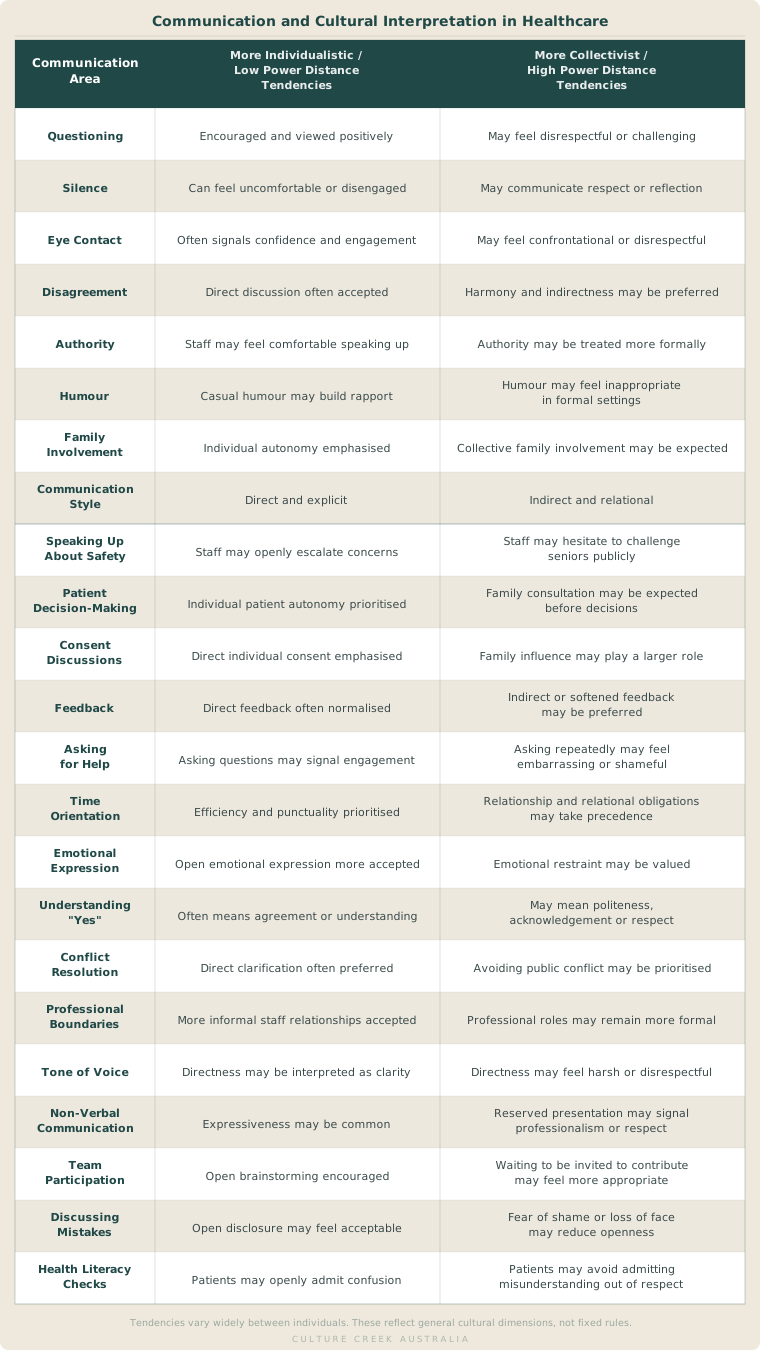
The graphic below highlights some common communication differences that can arise in multicultural healthcare settings. These are broad tendencies rather than fixed rules, and individual personalities, experiences and contexts will always vary.
If you want to give your team a shared language for these moments, our Communication for Safety course works through exactly the kind of cross-cultural interpretation this article describes.
References
-
Hofstede, G., Hofstede, G. J., & Minkov, M. (2010). Cultures and Organizations: Software of the Mind. 3rd ed. New York: McGraw-Hill. Power distance and individualism versus collectivism are two of Hofstede’s cultural dimensions. ↩
Updated 15 June 2026