When we were living in Uganda, I had an emergency caesarean. Afterwards the doctor ordered pethidine, a strong opioid painkiller, by injection, every four hours for the next twenty-four hours.
I didn’t need it.
I had trained as a nurse. I knew my own body, and the pain I was in was nowhere near the level that dose is meant for. But I had just come out of surgery, I was exhausted and foggy, and no one asked me how much pain I was actually in. The injections simply arrived on the schedule the doctor had set.
After the second one, I decided to speak up. I refused the next injection.
It did not go the way I expected. The nurse was bewildered. Why would I turn down what the doctor had ordered? In her world, a doctor’s instruction was not the opening line of a conversation. It was an order, and you did not question it. My refusal didn’t read as a patient taking part in her own care. It read as something close to defiance, and the communication between us broke down on the spot.
Here is what has stayed with me. Clinically, nothing was wrong. The drug was appropriate, the dose was standard, the order was carried out to the letter. On paper, I was receiving good care.
It still didn’t feel safe. Because no one asked me, and when I finally spoke, there was no room for my voice.
That gap, between care that is technically correct and care the patient actually experiences as safe, is what culturally safe practice is about.
What is culturally safe practice?
Culturally safe practice is care that the person receiving it experiences as safe, respectful and free of judgement. What makes it different from everything that comes before it is who gets to decide: not the clinician, not the chart, not the policy, but the patient.
That single shift is the whole idea. Cultural awareness and cultural competence both leave the provider as the judge. I am aware. I am competent. I have done the training. Cultural safety turns that around. It is the one term in this family that is defined by the person on the other side of the bed.
In Australia this isn’t a vague aspiration. It is written into the rules that govern every registered health practitioner. Ahpra, the national regulator, defines it like this:1
“Cultural safety is determined by Aboriginal and Torres Strait Islander individuals, families and communities. Culturally safe practise is the ongoing critical reflection of health practitioner knowledge, skills, attitudes, practising behaviours and power differentials in delivering safe, accessible and responsive healthcare free of racism.”
Read that first line again. The patient determines whether the care was safe. The Nursing and Midwifery Board of Australia puts the same idea more plainly: only individuals and their families can define what feels culturally safe.2 And the National Aboriginal and Torres Strait Islander Health Plan draws the line cleanly. Cultural safety is about how care is provided, not what care is provided.3
In that hospital in Uganda, the what was flawless. The how left me, an experienced nurse who knew exactly what was happening, unable to be heard.
Cultural awareness and competence are not the same as safety
For years, healthcare organisations have invested in cultural awareness and cultural competence: teaching staff about other people’s customs, beliefs and ways of communicating. That work has its place. Cultural awareness means noticing that differences exist. Cultural competence goes a step further, building the knowledge and skills to work across cultures.
But notice who is the judge in both of those. The clinician. Both are measured by the provider’s own sense of how much they know. You can complete every module, collect every certificate, and still leave a patient feeling unheard, because knowing about someone’s culture is not the same as that person experiencing your care as safe.
That is the line culturally safe practice draws. Competence is something you claim. Safety is something only the patient can grant. A clinician can be highly competent and still deliver care that doesn’t feel safe, exactly as happened to me in Uganda.
Where culturally safe practice comes from
Cultural safety didn’t begin as Australian policy. It started in nursing in New Zealand, developed by a Māori nurse, Irihapeti Ramsden, out of concern for the health of Māori patients and the unequal power between them and the system meant to care for them.4 In Australia it took root in Aboriginal and Torres Strait Islander health, and that is where the term is anchored. I want to be clear about that, because it’s the origin and it’s earned.
But here is where most of the conversation stops short. The nursing code that every nurse in the country works under now applies culturally safe practice to every patient, not one group. The principle was built in one place. It reaches a great deal further than that.
And the place it reaches furthest, the place almost no one is talking about, is the one I started with: a hugely multicultural workforce, caring for a hugely multicultural public, in thousands of encounters a day that no one thinks to call cultural safety at all.
Why culturally safe practice is a safety issue, not a courtesy
The word “safety” is doing real work here. This is not about being nice.
When a patient doesn’t feel safe, they go quiet. They leave out a symptom. They agree to a plan they don’t understand. They don’t come back. Each of those is a clinical event, even though none of them files a complaint or shows up as an error.
That is why the regulator’s definition leans so hard on one word: power. The imbalance between a patient and the system is real, and culturally safe practice asks the clinician to notice it and hand some of it back, to make it easy for the person in the bed to disagree, to ask again, to admit they didn’t follow.
It’s measurable, too. Hospitals track how often patients leave against medical advice precisely because walking out early is a sign that care didn’t feel safe enough to stay for.5 A patient who discharges themselves, or quietly stops coming back, has had a safety event, even though nothing went wrong on the chart.
Cultural safety is not about being polite. It is a clinical safety issue.
What culturally safe practice looks like at the bedside
This is where it gets practical, and it’s often simpler than people expect. The things that actually work are concrete, not abstract.6
Ask instead of assume
It looks like asking instead of assuming. “How would you prefer to be addressed?” rather than guessing. “Can you tell me in your own words what the plan is when you get home?” rather than “Do you understand?”, which only ever earns you a polite yes.
Adapt how you explain, not just what you say
A discharge instruction that makes sense to you may land as a wall of unfamiliar words to the person hearing it. Culturally safe practice means checking what actually got through, slowing down at the moments that carry risk, and using an interpreter when language could get in the way of consent rather than relying on a family member or a translation app to carry a medical conversation.
Make room for family
In many cultures, and in plenty of Australian families, a health decision is made together, not alone. A culturally safe clinician doesn’t treat that as interference. They work out who the patient wants in the room, and handle consent carefully from there.
Build a team where people can speak up
Culturally safe practice doesn’t stop at the bedside. Staff who feel they can’t question a senior colleague, clarify an instruction or raise a concern will stay silent at exactly the moments that matter most for safety.
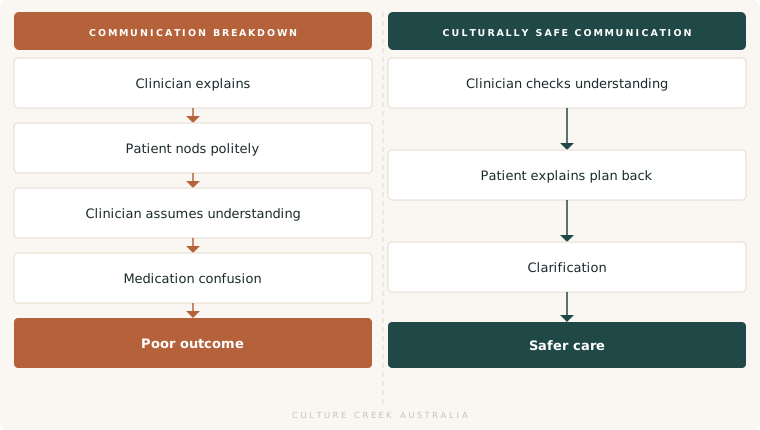
Don’t miss this: none of these is a checklist you complete and tick off. Cultural safety is judged fresh by every patient, every time. The work is ongoing self-reflection, what the researchers call critical consciousness,7 not a certificate on the wall.
Common mistakes, and what to do instead
Most breakdowns in culturally safe practice don’t come from anyone being careless. They come from a well-meaning clinician assuming their own normal is everyone’s normal. A few patterns come up again and again.
Treating silence or a nod as agreement. In plenty of cultures, questioning a clinician is disrespectful, so a patient nods, says “yes”, and leaves without a clue how to take the medication. The nod told you nothing. Instead, ask the person to tell you the plan back in their own words, and treat a quick “I’m fine” from someone who clearly isn’t as the start of the conversation, not the end of it.
Assuming consent is one person’s to give. Western healthcare treats the individual as the decision-maker. For many patients, a significant decision belongs to the family. Reading that as the patient being unable to decide for themselves, or as the family interfering, misses what is actually happening. Ask who the patient wants involved, rather than assuming it should be them alone.
Mistaking your own culture for no culture at all. It is easy to notice the patient’s accent, dress or beliefs and forget that your own way of running a consultation, direct, time-pressured, individual, is every bit as cultural. When something feels awkward, the instinct is to locate the problem in the patient. Culturally safe practice asks you to look first at the frame you brought into the room.
The conversation we’re not having
So let me come back to that hospital in Uganda. Because the nurse in that story is now working in Australia. Or someone just like her is.
A large share of our nurses, aged care workers and disability support workers were born overseas. So were many of our doctors.
Overseas-born workers in Australian care settings
Sources: ABS; GEN Aged Care Data; MCWH
That Ugandan nurse wasn’t unkind, and she wasn’t unskilled. She came from a system where you do not question a doctor’s order, and that shaped how she read a patient who did. Thousands of clinicians arrive in Australia every year from exactly that kind of system. It shapes how they hear a patient’s silence, whether they’ll speak up to a senior colleague, and how they read a quiet “I’m good” from someone who is anything but. In Australian healthcare, speaking up is tied directly to patient safety. For someone trained to defer, that is a real shift, and it is learnable.
There is a name for part of what is going on here. Sociologists talk about higher-trust and lower-trust societies: places where people generally extend trust to institutions, systems and strangers, and places where, often after a history of instability or corruption, trust is reserved for family and close relationships and rarely handed to a system. Australia sits towards the higher-trust end, and our healthcare culture quietly assumes it. We expect staff to speak up, treat questioning as fair game, and take it for granted that the rules are basically sound. A clinician who trained in a lower-trust setting may have learned the opposite: defer to authority, avoid open disagreement, and build trust slowly through relationship rather than assume it from a name badge. Read through an Australian manager’s lens, that can look like a lack of confidence. It usually isn’t. It is a different, and entirely rational, relationship with trust.
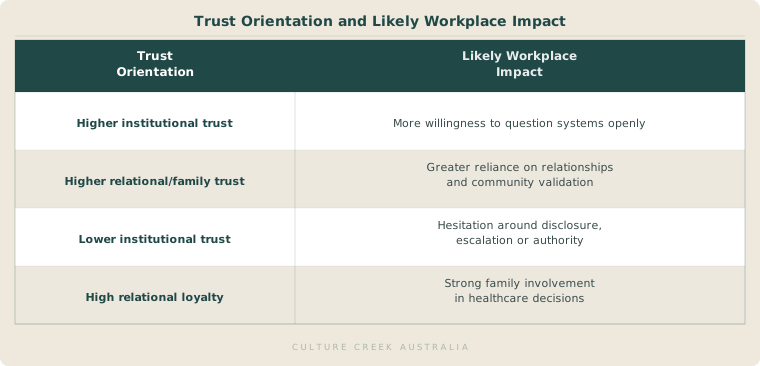
It runs the other way too. A patient with limited English nodding along to a discharge plan she hasn’t followed is the same safety gap from the other side of the bed. Neither person in that room is doing anything wrong. The culture sitting underneath the conversation is simply invisible to both of them.
The honest truth is that we are far better at saying these patients and these clinicians deserve culturally safe care than at describing what it actually looks like for them. Closing that gap, naming what good care looks like and giving teams the practical skills to deliver it, is exactly the work we do at Culture Creek. Our Communication for Safety course builds those skills for healthcare and care teams.
What culturally safe care actually feels like
For all the regulation around it, cultural safety comes down to something very human. One researcher described it as an outcome lived through self-reflection, truly listening to each other, and sharing respect and dignity in our everyday relationships. That’s it. That’s the whole thing.
I was lucky in that hospital in Uganda. I was a nurse. I knew what I’d been given, I knew I didn’t need it, and I had the confidence to refuse. Most patients have none of those advantages. They don’t know what’s normal, they can’t always find the words, and they will protect the person treating them before they’ll speak up for themselves.
Safe care doesn’t wait for them to find their voice. It goes looking for it.
If your organisation wants to strengthen communication, cultural fluency and psychologically safe practice, book a free consultation with Culture Creek Australia.
References
-
Ahpra & the National Scheme (2020). The National Scheme’s Aboriginal and Torres Strait Islander Health and Cultural Safety Strategy 2020–2025, p. 9. Read it. ↩
-
Nursing and Midwifery Board of Australia (2018). Code of Conduct for Nurses, culturally safe and respectful practice. Read it. ↩
-
Australian Government Department of Health (2021). National Aboriginal and Torres Strait Islander Health Plan 2021–2031. Read it. ↩
-
Ramsden, I. (2002). Cultural Safety and Nursing Education in Aotearoa and Te Waipounamu. Doctoral thesis, Victoria University of Wellington. ↩
-
Australian Institute of Health and Welfare (2023). Cultural Safety in Health Care for Indigenous Australians: Monitoring Framework (discharge against medical advice as an indirect measure of cultural safety). Read it. ↩
-
Fowler, K. & O’Loughlin, M. (2025). ‘Which Cultural Safety Strategies Are Making a Difference? Exploring Hospital Initiatives for First Nations Peoples in Australia. A Scoping Review.’ Journal of Clinical Nursing. Read it. ↩
-
Curtis, E., et al. (2019). ‘Why cultural safety rather than cultural competency is required to achieve health equity.’ International Journal for Equity in Health, 18:174. Read it. ↩
Updated 21 July 2026