
When we first moved from Australia to Uganda, everything was foreign. Where and how to shop, the products on the shelves, the markets where we bought our fruit, vegetables and meat, even the most basic services. As a young mother I needed to do the shopping, and at the market a purchase was never a simple transaction. Everything had to be bartered for, and that went against the deep grain of who I was.
Bartering is an art. Done well, both people walk away satisfied at a fair price. But I didn’t like arguing over a price, and I could not bring myself to engage in it, so I would end up paying far too much for something simply because I couldn’t play a game everyone around me had grown up with. I felt so disheartened and discouraged that after a short while I gave up and hired someone to do the shopping for me.
I was a capable adult, and none of this was beyond me. What defeated me was not the task. It was a cultural script I had never been taught, running underneath an everyday interaction, that left me feeling like I was getting it wrong every single time. So I withdrew.
I think about that often when I watch internationally trained clinicians arrive in Australia. They come highly qualified and deeply experienced, and their clinical skill is rarely the problem. What wears them down is the invisible cultural layer underneath every interaction: how directly to speak, when to question a senior, how to read the banter, what a patient’s silence really means. When someone feels they are getting it wrong over and over with no one to help them make sense of it, they do what I did at the market. They quietly disengage. The difference is that I could hire someone to do my shopping. A clinician cannot outsource the cultural fluency their job depends on, which is exactly why the organisation around them has to help build it.
Across Australia, healthcare providers are increasingly relying on internationally trained clinicians to strengthen their workforce. Hospitals, aged care providers, GP clinics and regional health services are all recruiting nurses, doctors and allied health professionals from overseas to address ongoing workforce shortages.
These clinicians often arrive highly qualified, deeply experienced and strongly motivated to contribute. Yet many organisations underestimate how challenging the first weeks and months of transition into Australian healthcare can be.
Clinical skill is only one part of successful integration.
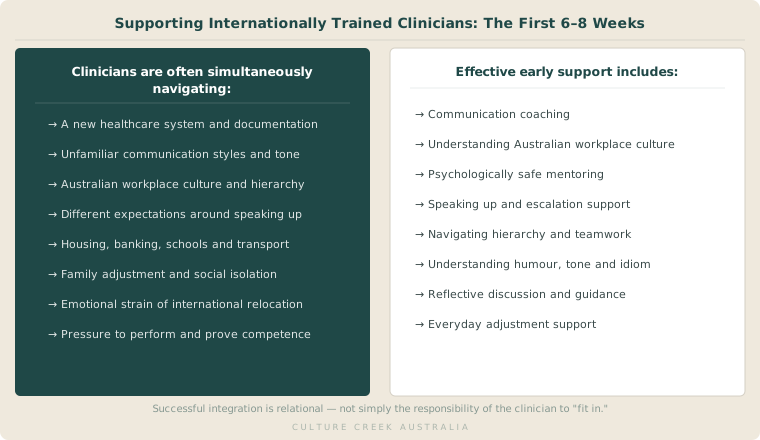
An internationally trained clinician is often adjusting to a great deal at once: a new healthcare system, unfamiliar communication styles, Australian workplace culture, new documentation and safety expectations, different approaches to hierarchy and teamwork, and the emotional strain of relocating to another country.
For many, the first 6–8 weeks are especially significant. That early adjustment period can strongly influence confidence, communication, team integration, retention, psychological wellbeing and patient safety itself.
Clinical competence does not automatically mean cultural familiarity
One of the most common mistakes organisations make is assuming that a clinically skilled healthcare professional will automatically adjust easily to Australian workplace culture. In reality, communication and workplace expectations vary significantly across cultures.
An internationally trained clinician may be entering a workplace where questioning senior staff is expected, patients are encouraged to take an active part in decisions, communication is more direct, hierarchy is less formal, and speaking up about a safety concern is treated as an important professional responsibility. Even small differences like these can become exhausting when they are experienced over and over throughout the day.
A clinician may understand English well and still struggle with humour, tone, accents, indirect language, idioms, rapid handovers, or reading how something was “meant.” Australian teams, meanwhile, may unintentionally misread behaviours through their own cultural lens. Quietness gets read as a lack of confidence. Hesitation looks like disengagement. Indirect communication is mistaken for uncertainty, and a reluctance to challenge authority is taken for poor critical thinking. In reality, many of these behaviours are shaped by deeply learned cultural patterns, not by competence or motivation.
Culture shock is real, even for experienced professionals
One thing often overlooked in healthcare onboarding is culture shock. When people relocate internationally, they are not simply changing jobs. They are adjusting to an entirely new social and cultural environment.
Even highly resilient, experienced clinicians can feel loneliness, emotional exhaustion, confusion, homesickness, a sense of identity disruption, anxiety about communication, or a constant feeling of “getting things wrong.” Often they are trying to sort out housing, transport, banking, schools, healthcare, social isolation and family adjustment all while learning a new workplace culture.
Many also carry significant pressure to perform well, support family financially, avoid mistakes and prove themselves professionally. Without adequate support, that pressure can quietly erode confidence, communication, wellbeing and long-term retention.
Why the first 6–8 weeks matter so much
In my experience working cross-culturally and supporting healthcare teams, the early onboarding period is often where organisations have the greatest opportunity to strengthen both retention and communication safety. The first weeks are when clinicians are trying to make sense of workplace expectations, communication norms, professional relationships and what counts as “normal” in Australian healthcare. It is also the period when misunderstandings happen most easily.
One insight that strongly shaped my own thinking came through Milton Bennett’s work on intercultural sensitivity, where he quotes psychologist George Kelly:
“People do not respond directly to events; they respond to the meaning they attach to events.”1
That is highly relevant in onboarding. An internationally trained clinician is rarely just learning new procedures. They are learning how to interpret communication, authority, teamwork, questioning, patient expectations and workplace relationships inside a completely different cultural context. Direct feedback may at first feel harsh or personal. Casual workplace banter may feel unfamiliar. Speaking up may feel uncomfortable, and a patient questioning medical advice may come as a surprise. Australian staff, in turn, may misread culturally shaped behaviours. Many communication difficulties during onboarding happen not because anyone lacks goodwill, but because two people are attaching different meanings to the same interaction.
Effective onboarding is relational, not just procedural
Many onboarding programs focus heavily on compliance, orientation, policies, systems training and mandatory competencies. All of that is important. But an internationally trained clinician usually also needs relational support, communication coaching, culturally safe mentoring, and practical guidance for the everyday interactions of an Australian workplace. This matters especially in rural and regional settings, in aged care, in multicultural environments, and in workplaces already under pressure.
Support in the first 6–8 weeks helps a clinician build confidence, ask questions more safely, understand what is expected of their communication, find their feet in workplace dynamics, and integrate more smoothly into the team. Importantly, this support should never feel punitive or remedial. International clinicians are not “problems to fix.” They are highly valuable healthcare professionals adapting to a new cultural and professional environment.
What supportive onboarding can include
Effective cultural onboarding and coaching might cover communication coaching, understanding Australian workplace culture, psychologically safe communication, speaking up and escalation, understanding patient expectations, finding your way around hierarchy and teamwork, reading humour, tone and informal communication, reflective discussion, and support around the everyday challenges of settling in. It may also involve helping managers and teams better understand how culture shapes communication and behaviour.
Successful integration is always relational. It is not simply the responsibility of the internationally trained clinician to “fit in.” Teams and organisations also play a role in creating psychologically safe and culturally responsive workplaces.
Supporting retention through connection and communication
Healthcare organisations invest enormous time and resources into international recruitment. Yet retention often depends less on the recruitment itself and more on communication, support, belonging, confidence and those early workplace experiences. When internationally trained clinicians feel welcomed, understood, psychologically safe, supported and able to ask questions, they are far more likely to integrate successfully, communicate confidently, contribute fully, and stay with the organisation long term.
At Culture Creek Australia, we support healthcare organisations through practical cross-cultural onboarding and coaching for internationally trained clinicians, focusing on communication, Australian workplace culture, and support during the critical early adjustment period.
Our approach is warm, practical and grounded in real-world healthcare communication, helping internationally trained clinicians not only work safely in Australia, but feel more confident, connected and supported while doing so.
If your organisation is preparing to onboard internationally trained clinicians, book a free consultation with Culture Creek Australia to discuss tailored onboarding, communication and coaching support for your team.
References
-
Kelly, G. A. (1963). A Theory of Personality: The Psychology of Personal Constructs. New York: W. W. Norton. Quoted in Bennett, M. J. (1986), “A Developmental Approach to Training for Intercultural Sensitivity,” International Journal of Intercultural Relations, 10(2), 179–196. ↩
Updated 15 June 2026