When we lived in Africa, friends and the people I worked alongside would come back from the doctor with a bag of medicine and almost no idea what it was for.
I would ask the questions that seemed obvious to me. What did the doctor say? What is actually wrong? How long until you are better? Did they explain any of it?
Often they didn’t know. And here is the part that stopped me: they weren’t worried about not knowing. They hadn’t asked, and it hadn’t occurred to them to ask.
It took me a while to understand what I was looking at. In their world, a doctor sat at the top of an order you did not question. Asking for an explanation wasn’t a right to use; it could look like doubt, or disrespect. The silence I read as a problem, they didn’t read as anything at all.
Then came the harder realisation, the one that took longer. I was doing the same thing they were, just from the other direction. I was reading the whole exchange through my own assumptions about what a patient is supposed to do: ask questions, push back, take charge of the conversation. Those assumptions felt like plain common sense to me. They were every bit as cultural as theirs.
Decades before I ever noticed any of this, a Māori nurse in New Zealand had given it a name.
The nurse who named it
Cultural safety didn’t come out of a policy committee. It came from Irihapeti Ramsden, a Māori nurse and educator in Aotearoa New Zealand, who spent the 1980s and 90s asking why Māori patients so often experienced the health system as cold and alienating, even when the staff were sure they were being perfectly kind.
Her answer was uncomfortable, and it is still the heart of the idea. The problem wasn’t that nurses didn’t know enough about Māori customs. You could hand every nurse a booklet of cultural facts and change nothing. The problem was what nurses carried into the room without noticing: their own culture, their own assumptions, and the power sitting on their side of the bed.
So Ramsden turned the work around. Cultural safety, she argued, is not the clinician becoming an expert in the patient’s culture. It is the clinician becoming honest about their own. In her words, it is “about protecting people from nurses, from our cultures as health professionals, our attitudes, our power.”1
And then the part that still does the most work. Who gets to decide whether care was safe? Not the clinician. Cultural safety, Ramsden wrote, “enables safe service to be defined by those that receive the service.”1 The patient is the judge. Every time.
One thing worth being clear about, because it shapes everything below. Ramsden built this in and for Indigenous health, and that is where it is anchored. But she used the word “culture” in its widest sense, age, gender, class, migration, belief, not only ethnicity. She meant it to describe any encounter where one person’s world meets another’s. In Australian healthcare, that is most of them.
Ramsden’s ladder of awareness, sensitivity and safety
Ramsden was careful that these are three different things, not three words for the same one. People muddle them constantly.
| Ramsden’s step | What it is | Who does the work |
|---|---|---|
| Cultural awareness | Noticing that difference exists | You, just noticing |
| Cultural sensitivity | Seeing that your own background shapes how you read everyone | You, on yourself |
| Cultural safety | Care the patient experiences as safe | The patient decides |
Cultural awareness, she said, “is a beginning step towards understanding that there is difference.”1 Useful, but only a beginning. You can be fully aware that people differ and still treat them badly.
Cultural sensitivity goes further. It is the moment you realise that you, too, are a “powerful bearer” of your own life and background, and that it colours how you read the person in front of you. This is the step most training skips straight past.
Cultural safety is the outcome: care the patient judges as safe, on their reckoning, not yours.
“Cultural Safety is defined by those people that are receiving this service, not by those delivering it.” (Irihapeti Ramsden)1
(You will sometimes hear “cultural humility” used in this space. It is a related and useful idea, but it came later and from different authors. Ramsden’s own ladder ran awareness, then sensitivity, then safety.)
The principles, and what they look like at the bedside
Strip away the academic language and Ramsden’s foundation comes down to a handful of things a clinician actually does. They are more practical than they sound.
1. Start with yourself, not the patient
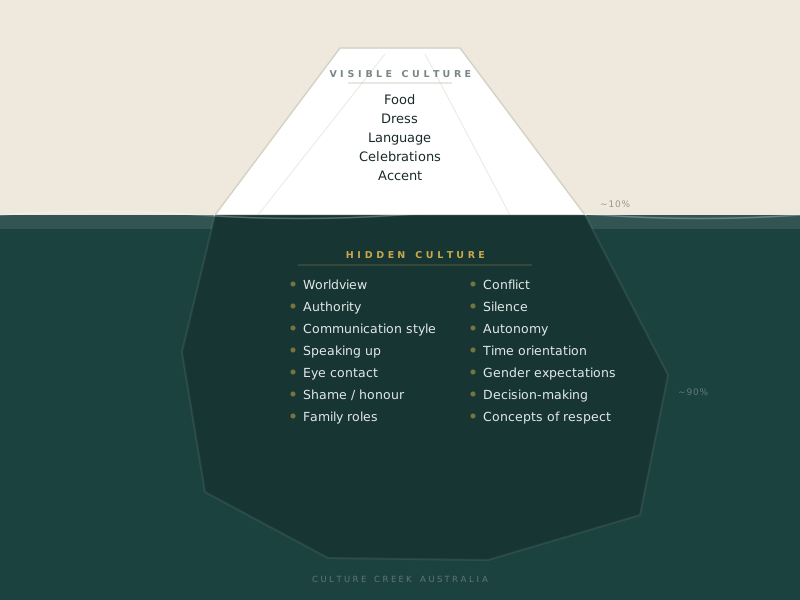
Reflection sits at the heart of cultural safety, and it points inward first. It asks you to examine how your own upbringing, communication style and assumptions shape the way you read other people.
This was the biggest shift for me. Before living and working overseas, my own habits were invisible to me, because they simply felt like the normal way to do things. It was only from the outside that I started to see how differently people read authority, questioning, silence, eye contact, humour and disagreement.
I have watched the same light go on in clinicians I have trained. Good people, genuinely wanting to communicate well, who had never been shown how deeply their own worldview shapes the way they explain things and the way they read the response. In practice it looks like a few honest questions mid-consultation. Am I assuming this patient understood because they nodded? Am I reading their silence through my own lens? Am I rushing this because my own style values speed and directness?
Most of what trips up cross-cultural communication stays invisible until you learn to see it. And most people can’t reflect on their own culture until they have first learned to notice it at all.
2. Close the power gap
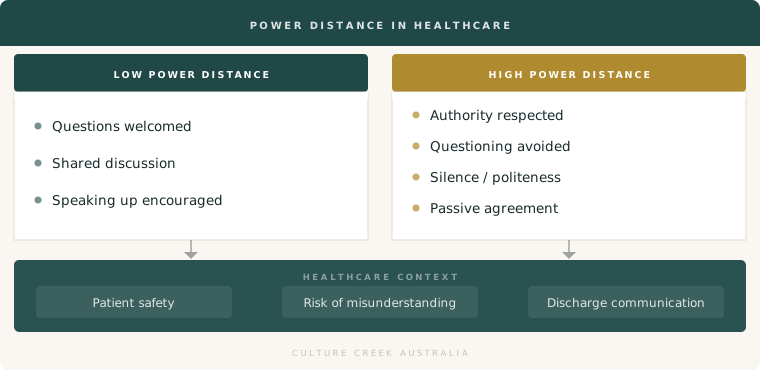
Healthcare runs on unequal power. The clinician holds the knowledge, the authority and the decisions. The patient is often unwell, anxious, and reluctant to look foolish. Ramsden named this plainly: cultural safety is partly about protecting people from our power as professionals.
It gets sharper across cultures, because attitudes to authority vary so much. Think of those friends of mine coming home with a bag of pills and no questions asked. In many cultures a doctor is an authority you simply do not interrogate, and pushing for more can feel rude or pointless.
Closing the gap is more than being friendly. It means deliberately building interactions where a patient feels able to ask, to say they are confused, and to take part in their own care.
3. Make it a conversation, not a handover
Ramsden framed safe care as a partnership, where, in her words, “patient and nurse are co-participants.”1 That is a long way from delivering instructions and ticking a box.
The classic mistake is treating silence as agreement, one of the cultural assumptions that quietly cause clinical errors. A patient may nod and say yes while still completely lost about their medication or their discharge plan, simply because asking again feels like an imposition. The fix is small and it works: instead of “Do you understand?”, which only ever earns a polite yes, ask “Can you tell me in your own words what the plan is when you get home?”
That one change turns passive agreement into a real conversation, where you can actually hear what hasn’t landed.
4. Care that’s regardful, not regardless
This is the idea I keep coming back to, and it is the cleanest thing Ramsden gave us.
For a long time the nursing ideal was to treat every patient exactly the same, regardless of background. It sounds fair. It even sounds noble. But Ramsden saw the flaw: care delivered “regardless” of who someone is quietly erases the person. She argued for the opposite, care that is “respective rather than irrespective” of difference.1 Care that is regardful of the person, not blind to them.
In practice that means holding your own framework a little more loosely. Western, biomedical medicine is excellent, and it is not the only way people make sense of illness, family and authority. Some patients want decisions made with the whole family, not alone. Some need to trust you as a person before they will tell you what is really wrong. Some, including many Aboriginal patients, carry a wariness of the system that history has more than earned.
None of this means lowering your clinical standards. It means fitting the care to the actual person in front of you rather than the average patient in a textbook. Ramsden called part of this work “decolonisation.” You don’t have to warm to the word to grasp the point: notice the person, and have regard for them.
Where this sits in Australian rules now
This is no longer just New Zealand theory. In Australia, the Nursing and Midwifery Board now treats culturally safe practice as a professional expectation. Its guidance asks practitioners to reflect on their own culture and assumptions, to address power imbalances, to communicate respectfully, and to provide care free from racism and discrimination.2
Read back over Ramsden’s foundation and you will recognise every one of those. The regulation is newer. The idea underneath it is hers.
Why the principles matter for ordinary care
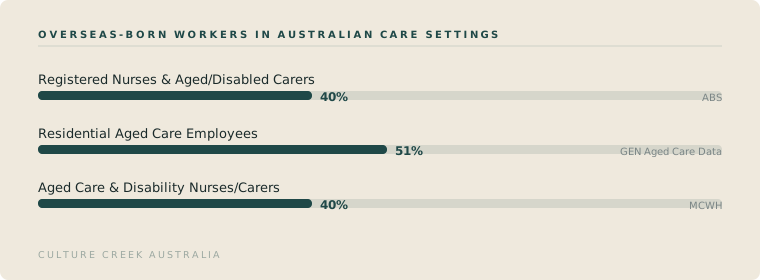
These are not soft skills for a training module. They decide very concrete things: whether a patient asks the question they walked in with, whether a staff member speaks up when something looks wrong, whether a misunderstanding gets caught early or after it has done damage.
And in Australia they reach a long way past the context Ramsden started in. A large share of our nurses, aged care workers and support workers were born overseas, as were many of our doctors. Add the patients, multicultural families, recently arrived migrants, anyone working through a system in their second or third language, and almost every encounter has two cultures in the room, not one.
That is exactly what Ramsden meant by culture in its broadest sense. The principles were built for Indigenous health, and they describe what good care looks like for all of it.
Cultural safety is not about becoming an expert in every culture you will ever meet. It is about becoming an expert in noticing the assumptions you carry into the room, and staying willing to listen, check and adjust.
I couldn’t have given those friends in Africa safer care by studying their culture harder. I would have had to start by seeing my own. That is Ramsden’s whole point, and it has lost none of its force: care that is regardful, not regardless.
If your organisation wants to strengthen culturally safe and psychologically safe practice across its teams, explore our Communication for Safety course or book a free consultation with Culture Creek Australia. This article is a companion piece to Culturally Safe Practice: What It Looks Like in Australian Healthcare.
References
-
Ramsden, I. (2002). Cultural Safety and Nursing Education in Aotearoa and Te Waipounamu. Doctoral thesis, Victoria University of Wellington. Source of the awareness/sensitivity/safety distinction, the ‘regardful, not regardless’ framing, and the definition of safety as judged by the recipient. ↩ ↩2 ↩3 ↩4 ↩5 ↩6
-
Nursing and Midwifery Board of Australia (2018). Code of Conduct for Nurses, culturally safe and respectful practice. Read it. ↩
Updated 11 June 2026