
One of the stories I hear again and again from clinicians new to Australia goes like this. They are working in a rural or remote town, they call an Aboriginal patient in for a consultation, and the whole family comes in with them. The clinician stands there, unsure. Who is the patient? Who am I meant to speak to? Often they end up quietly stepping out to ask a colleague what to do.
It is an awkward moment. But notice where the awkwardness actually sits.
It isn’t in the family arriving together. It’s in the clinician’s expectation that healthcare happens between one professional and one patient, and everyone else is in the way. The event is the same either way. The meaning the clinician attaches to it is what makes it feel confusing or normal.
I have seen versions of this across many cultures, not just in remote Australia. In much of Africa, where I lived for years, a health decision rarely belongs to one person. It belongs to the family, and a patient may genuinely not want to answer until the family has talked it through. Read one way, that looks like interference. Read another, it is care, responsibility and love doing exactly what they are supposed to do.
That gap, between what happens and what we think it means, is where cultural care lives.
What cultural care in healthcare actually means
Cultural care in healthcare means providing care in a way that respects how a person’s culture, worldview, communication style, family relationships and lived experience shape the way they understand illness, support, safety and the healthcare interaction itself.
It is not a separate clinical framework the way cultural safety or cultural humility are often described in the literature. It is the practical, everyday version of all of them. If awareness, humility and safety are the ideas, cultural care is what they look like at the bedside on a Tuesday morning.
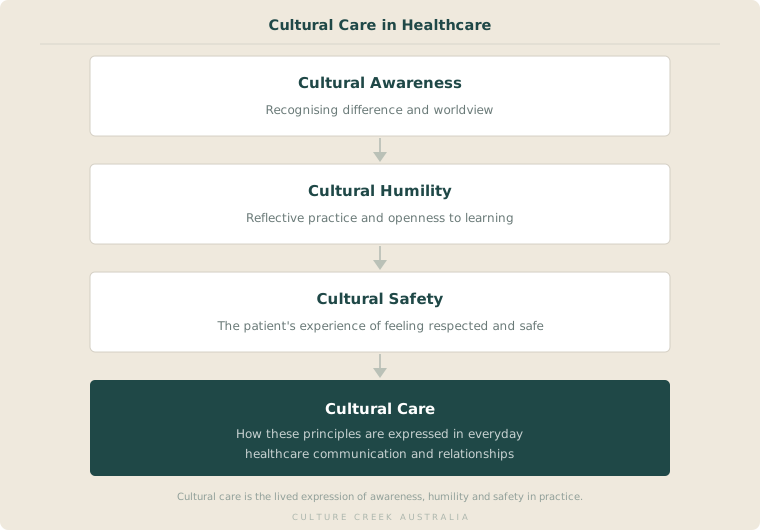
Cultural awareness helps healthcare workers recognise that people may communicate and interpret care differently.
Cultural humility keeps us reflective and open to learning from patients and families, rather than assuming we already understand their experience.
Cultural safety asks whether the patient themselves feels respected, understood and safe in the interaction.
Cultural care brings all three into ordinary communication and relationships.
It is not about avoiding offence or memorising facts about different cultures. It is about helping people feel understood, respected and safe enough to take part in their own care.
Why cultural care matters in Australia
In Australia, cultural care is becoming harder to treat as optional, because both the population and the workforce are deeply multicultural.
Almost one-third of Australians (31.5% in 2024) were born overseas, the highest share since 1893.1 Close to half have at least one parent born overseas.2 At the same time, our healthcare, aged care and disability sectors lean heavily on multicultural workforces.
And people understand communication, authority, questioning, family, illness and even “good care” very differently depending on where they come from. Those differences are in the room every single day.
What cultural care looks like in practice
Cultural care usually shows up in small moments of communication, not grand gestures.
A clinician explains discharge instructions clearly and professionally, and the patient still leaves without understanding the medication plan. The barrier may not be language. In some cultures, questioning a health professional feels disrespectful or intimidating, so the patient nods rather than asks.
A support worker reads a family’s heavy involvement as controlling, while the family see collective decision-making as the most basic expression of love and duty.
A patient avoids eye contact and is listening intently.
A colleague stays silent through handover, not because they agree, but because they don’t feel safe ending authority.
A patient says “I’m fine,” and means I don’t want to be a burden, or I’m embarrassed, or I’m not ready to talk about this yet.
None of this is solved by knowing more facts about more cultures. The most culturally capable healthcare workers I meet are rarely the ones with the most cultural trivia. They are the ones who stay curious, listen, notice their own assumptions, and check how their communication is being received rather than just delivered. That habit of noticing is the heart of cultural awareness training, and it is also the engine of cultural humility.
Why cultural care matters for patient safety
Cultural care is not simply kindness, diversity or inclusion. In healthcare, it is tied directly to patient safety.
Misunderstandings around consent, medication instructions, speaking up, discharge planning, escalation of concerns, family communication and treatment adherence can all change clinical outcomes. Silence gets mistaken for understanding. A patient agrees politely while staying deeply confused. A staff member from a strongly hierarchical background hesitates to question an unsafe instruction.
These are not soft interpersonal issues. They are safety issues, which is why Australia’s national standards build communication and consumer partnership in deliberately, through the Communicating for Safety and Partnering with Consumers standards.3 People communicate more safely when they feel respected, heard, and safe enough to ask a question or admit they didn’t follow something. This is the practical face of culturally safe practice.
Cultural care requires reflection, not perfection
One of the most freeing things I have learned through cross-cultural work is that cultural care is not about becoming an expert in every culture. That is impossible, and chasing it is exhausting.
It is about becoming more aware of our own assumptions, our own communication style, and the simple fact that another person may attach a completely different meaning to the same interaction.4
This is why cultural care cannot be reduced to a checklist or a compliance module. It develops. People recognise their own invisible assumptions, and suddenly interactions that felt baffling start to make sense. I have watched that light-bulb moment land on the faces of doctors, nurses and support workers more times than I can count. Once, it landed on a clinician who finally understood why the whole family had walked in together, and stopped seeing it as a problem to manage.
This is also why internationally trained clinicians deserve real support as they learn an unfamiliar system, rather than being left to work it out in the consult room.
How Culture Creek approaches cultural care
At Culture Creek Australia, this is the focus of our communication and cultural awareness training.5 Rather than teaching facts about different cultures, we help healthcare and care teams strengthen intercultural awareness, psychologically safe communication, reflective practice, and practical communication skills for real-world healthcare settings.
Using real healthcare examples, reflective discussion and communication-based learning, we help teams move past being told to “be culturally aware” toward genuine insight, adaptability and safer everyday communication.
If your organisation wants to strengthen cultural care, communication and psychologically safe practice, explore our Communication for Safety course or book a free consultation with Culture Creek Australia.
References
-
Australian Bureau of Statistics (2025). Australia’s Population by Country of Birth. In 2024, 31.5% of the estimated resident population were born overseas, up from 30.7% in 2023, the highest proportion since 1893. Read more. ↩
-
Australian Bureau of Statistics (2022). Cultural Diversity of Australia, 2021 Census: almost half (48.2%) of Australians had a parent born overseas. Read more. ↩
-
Australian Commission on Safety and Quality in Health Care. National Safety and Quality Health Service (NSQHS) Standards, including the Communicating for Safety Standard and the Partnering with Consumers Standard. Read more. ↩
-
Kelly, G. A. (1963). A Theory of Personality: The Psychology of Personal Constructs. New York: W. W. Norton. Quoted in Bennett, M. J. (1986), “A Developmental Approach to Training for Intercultural Sensitivity,” International Journal of Intercultural Relations, 10(2), 179–196: “People do not respond directly to events; they respond to the meaning they attach to events.” ↩
-
Nursing and Midwifery Board of Australia & Ahpra. Code of Conduct and Professional Standards. Read more. ↩
Updated 12 June 2026