
In NDIS service delivery, communication is not part of the service. It is the service.
A support worker does not deliver the support and then communicate about it on the side. The way a plan is explained, the question that does or does not get asked, the “yes” that may or may not mean yes: that is the support. When the communication misfires, the service misfires with it.
Now add the part most NDIS communication guides leave out. In Australia today, both the people receiving support and the people delivering it are deeply multicultural. Almost one-third of Australians (31.5% in 2024) were born overseas, and close to half have at least one parent born overseas.1 In frontline care and support work the proportion is higher still: nearly four in ten workers were born overseas at the last census.2 Yet culturally and linguistically diverse participants remain underrepresented in the NDIS itself.3 Generic communication tips, written as though everyone shares one set of assumptions, do not survive that complexity.
This is what effective communication in NDIS work actually has to reckon with: not just giving information clearly, but understanding how culture, family, authority, disability and trust shape the way a participant receives it.
Over the years I have become convinced that most communication difficulties in care settings do not happen because people lack compassion or skill. They happen because two people are quietly interpreting the same moment through different cultural assumptions, and neither of them knows it. As the psychologist George Kelly put it, in a line Milton Bennett later made central to his work on intercultural sensitivity, “People do not respond directly to events; they respond to the meaning they attach to events.”4
That is the whole game in disability support. A support worker may believe they are encouraging independence while the family experiences the same words as cold and unsafe. A participant may agree warmly with a plan they did not follow and would never challenge. The event is identical. The meaning is not.
Why effective communication in NDIS matters more than in most settings
Communication matters everywhere, but disability support workers enter unusually personal ground: people’s homes, routines, bodies, finances and family systems, often over months and years rather than a single appointment. Trust is not a nicety in that relationship. It is the thing that makes the support possible at all.
For culturally diverse participants and families, that trust is shaped by more than the task at hand. Religious belief, attitudes to disability, the weight given to family authority, the experience of migration, and what “independence” is even understood to mean can all sit underneath a simple conversation. In many more collectivist cultures, including some Asian, African and Middle Eastern contexts, caring for a relative with disability is held as a shared family responsibility rather than something handed to an outside service. That single difference can reshape how a whole family approaches the NDIS. Read without any cultural awareness, a worker can misread the family’s involvement, the participant’s silence, or a polite “yes” entirely.
What many NDIS communication frameworks still miss
Most communication training in disability support covers the right ground: active listening, person-centred practice, plain language, consent, documentation and communication supports. All of it matters. What it tends to skip is deeper, and harder to put on a checklist: people genuinely interpret communication itself differently across cultures.
A worker may assume that direct questioning shows respect, that eye contact shows engagement, that independence is always the goal, or that a participant will speak up if something is wrong. Each of those is a cultural assumption wearing the disguise of common sense. I know, because before I lived and worked cross-culturally, my own assumptions were just as invisible to me. They only became visible once I was somewhere they no longer fit. That shift, from “this is normal” to “this is one way of seeing it,” is the heart of cultural awareness training, and it is what these six strategies are built on.
Six strategies for effective communication with culturally diverse NDIS participants
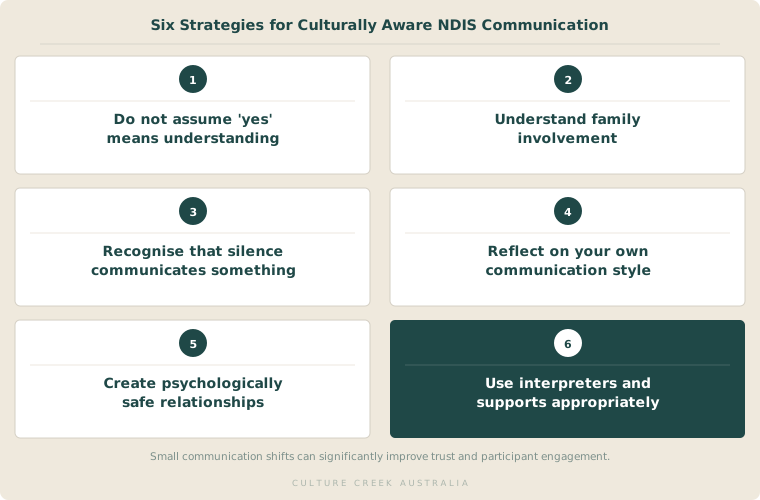
1. Do not assume “yes” means understanding
The most common mistake across cultures is hearing agreement and assuming comprehension. A participant or family member may say “yes” out of politeness, respect, embarrassment, anxiety, or simple reluctance to look difficult. Rather than asking “Do you understand?”, ask them to show you: “Can you tell me what the plan will look like after I leave today?” That gives you the truth without putting anyone to shame.
2. Find out how each participant prefers to communicate, and write it down
Preferred language, the need for an interpreter, who the participant wants in the room, and how they like information given are not details to rediscover at every visit. Establish them early, document them in the participant’s file, and make sure the next worker inherits them. Effective communication in NDIS support is a team effort, and it breaks down when knowledge lives only in one worker’s head.
3. Understand the role of family
Family involvement looks very different from one culture to the next. Some families expect to make decisions together and feel a deep duty to advocate for a relative with disability. Others are uncomfortable involving an outside service at all. Workers sometimes read strong family involvement as controlling when it is actually care, obligation and cultural responsibility doing their job. Being culturally aware does not mean setting aside participant autonomy or Australian legal frameworks. It means recognising that people understand support, and who it belongs to, in different ways.
4. Treat silence as information, not a gap to fill
Silence does not always mean agreement or understanding. It can carry respect, uncertainty, emotional processing, discomfort, or an unwillingness to challenge someone in authority. A worker who rushes to fill every pause can talk straight past a concern that was about to surface. Slowing down, and letting a silence sit, often does more for trust and understanding than another sentence would.
5. Reflect on your own communication style
Cultural awareness starts less with learning about other people and more with noticing yourself. Most support workers have never been asked to consider how their own culture shapes their directness, their humour, their comfort with conflict, their eye contact, or their relationship to authority. Yet those assumptions are at work in every interaction. This is why telling staff to “be culturally aware” is rarely enough on its own. People need the chance to see their own worldview before they can adjust how it lands on someone else.
6. Use interpreters early, and build cultural reflection into supervision
A professional interpreter belongs at the start of an important relationship, not only at the point where something has already gone wrong. Interpreters matter most in planning meetings, consent discussions, healthcare appointments and any complex conversation, and the job is never only swapping words: tone, authority and cultural context all travel with the meaning. Keep speaking to the participant directly rather than talking only to the family or the interpreter. And carry this thinking beyond onboarding into supervision and case notes, where reflecting on what was understood, not just what was said, keeps cultural awareness alive in everyday practice.
The multicultural support workforce matters too
Australia’s disability and support workforce is increasingly multicultural itself, and that brings real strengths: empathy, language, adaptability, community connection and a deep familiarity with care as a relationship. It also brings its own communication needs. A worker raised in a strongly hierarchical workplace culture may hesitate to challenge an unsafe practice, ask a clarifying question, or raise a concern with a supervisor. A manager without any intercultural awareness can misread that hesitation as disengagement or a lack of initiative, when it is nothing of the kind. Psychologically safe leadership is what lets that worker’s strengths show and their concerns surface.
What good looks like in practice
Picture a support worker sitting in on an NDIS planning meeting. The participant’s extended family answers many of the questions and is clearly central to the decisions being made. A worker unfamiliar with these dynamics might grow frustrated, reading the situation as the participant being talked over or held back from independence.
But the worker slows down, listens, and asks the family about their thinking. It becomes clear that this family makes support decisions collectively, and sees that involvement as an expression of care rather than control. The worker still upholds the participant’s rights and autonomy, but now communicates with the family rather than around them. That one shift in interpretation changes the entire tone of the relationship, and the trust inside it. It is the same instinct that sits behind cultural care in healthcare: meet people where their understanding actually is.
Communication is central to safe and respectful NDIS support
In NDIS service delivery, communication is not part of the service. It is the service.
Effective communication in NDIS service delivery is tied directly to participant safety, trust, wellbeing, advocacy, autonomy and the quality of the support relationship itself. In a multicultural sector, none of that can be separated from culture, worldview and interpretation. And the most culturally capable workers are rarely the ones who have memorised the most facts about other cultures. They are the ones who stay curious, notice their own assumptions, listen closely, and build relationships where a participant feels safe enough to say what they really think. You can see the same habit at work across our everyday cultural awareness examples.
If your organisation wants to strengthen this in practice, Culture Creek runs practical workshops for NDIS and care providers, with bulk seats for teams, and a Communication for Safety course built for multicultural Australian care settings. We also offer one-on-one coaching for support workers and team leaders, or you can book a free consultation to talk through what your team needs.
References
-
Australian Bureau of Statistics (2025). Australia’s Population by Country of Birth (31.5% born overseas in 2024); and (2022) Cultural Diversity of Australia, 2021 Census (48.2% had a parent born overseas). Country of birth; cultural diversity. ↩
-
UNSW, Migrant Workers in Frontline Care (factsheet). At the 2016 Census, 37.1% of frontline care workers were born overseas, higher than the overseas-born share of the workforce overall. Read more. ↩
-
National Disability Insurance Agency. Cultural and Linguistic Diversity Strategy, which recognises that CALD participants are underrepresented among NDIS participants. Read more. ↩
-
Kelly, G. A. (1963). A Theory of Personality: The Psychology of Personal Constructs. New York: W. W. Norton. Quoted in Bennett, M. J. (1986), “A Developmental Approach to Training for Intercultural Sensitivity,” International Journal of Intercultural Relations, 10(2), 179–196. ↩
Updated 12 June 2026